
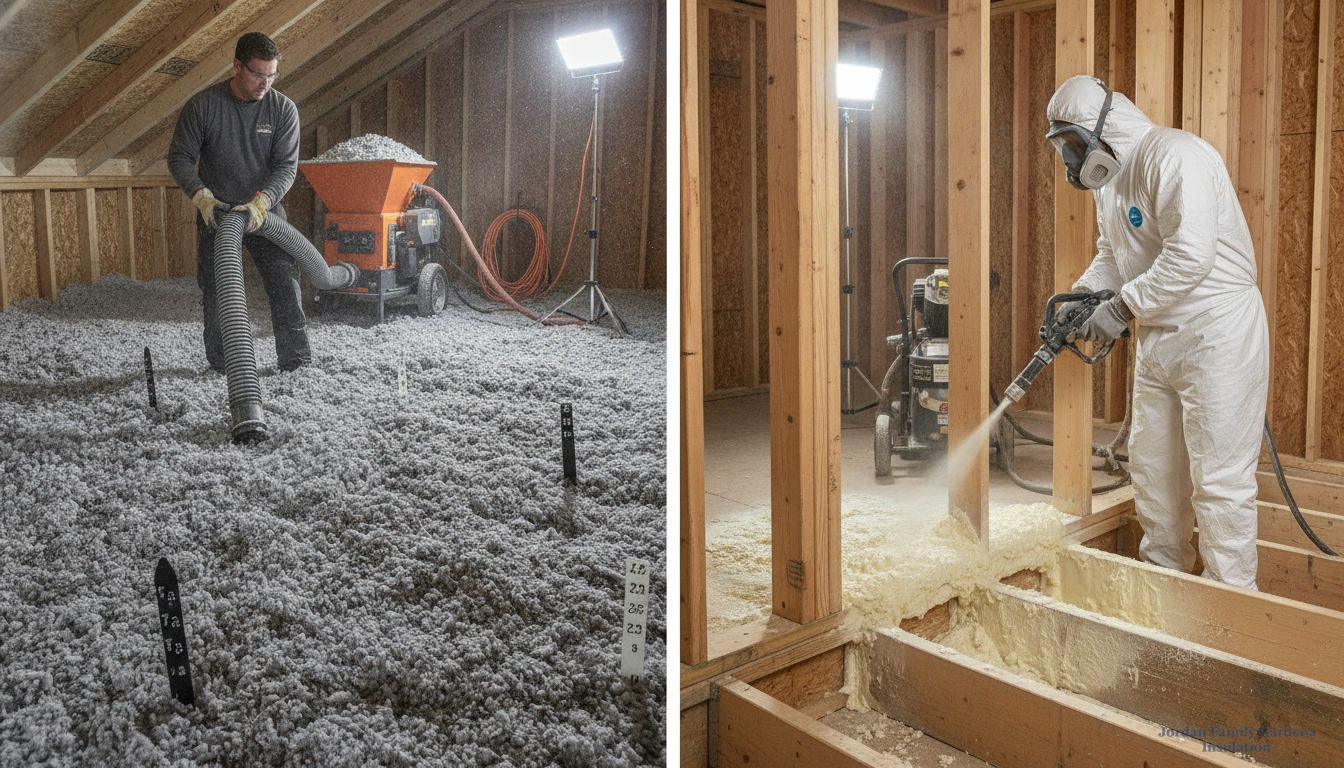
Choosing the Right Insulation for Gardena's Climate
Gardena sits in one of Los Angeles County's warmest inland coastal zones, where summer temperatures regularly demand long hours of air conditioning and winter nights can turn surprisingly cool. Choosing the right type of insulation for your home isn't just about picking the product with the highest R-value on paper — it's about matching the material and installation method to your specific attic configuration, wall assembly, crawl space conditions, and budget.
At Jordan Family Gardena Insulation, the two questions we hear most from homeowners comparing options are: Should I go with blown-in insulation or spray foam? This guide is designed to help you understand both products so you can make a confident, informed decision before your free estimate.
What Is Blown-In Insulation?
Blown-in insulation uses a commercial blowing machine to propel loose-fill fiberglass or cellulose into an attic floor or wall cavity. The material settles into a consistent thermal blanket that conforms to every joist bay, rafter, corner, and obstruction without leaving cold spots or gaps.
Fiberglass blown-in offers excellent moisture resistance and long-term dimensional stability — a good fit for Gardena attics that may experience occasional humidity fluctuations. Cellulose blown-in is made from recycled paper fiber treated with borate for fire and pest resistance, making it an eco-conscious choice popular with South Bay homeowners.
Blown-in insulation is ideal for:
- Existing attic floors where adding R-value quickly and economically is the goal
- Attics with complex framing, cross-bracing, or existing wiring where batts won't fit cleanly
- Walls where injection foam is not needed but coverage must be thorough
- Large-square-footage applications where cost-per-square-foot matters
Explore our complete blown-in insulation service for details on materials and installation process.
What Is Spray Foam Insulation?
Spray polyurethane foam (SPF) is applied as a liquid that expands rapidly to fill cavities, adhere to surfaces, and cure into a rigid or semi-rigid foam. It delivers some of the highest R-values per inch available and simultaneously acts as an air barrier and, in the case of closed-cell foam, a vapor retarder.
We install two types of spray foam at Jordan Family Gardena Insulation:
- Closed-cell spray foam — approximately R-6 to R-7 per inch, rigid, vapor-retarding, and structurally reinforcing. Best for crawl space walls, rim joists, vaulted ceilings, and new construction cavities where maximum performance in a thin profile is required.
- Open-cell spray foam — approximately R-3.5 per inch, softer, vapor-permeable, and more economical. Ideal for interior walls, attic undersides in conditioned attic designs, and spaces where some vapor transmission is desired.
Spray foam is ideal for:
- Rim joists and band joists where air infiltration is highest
- Crawl space perimeter walls in unvented configurations
- Cathedral ceilings and shallow rafter bays where achieving code R-value with batts is impossible
- New construction where open cavities allow full application before drywall
See our full spray foam insulation service page to learn more about open and closed-cell applications.
Side-by-Side Comparison: Blown-In vs. Spray Foam
- R-value per inch: Blown-in fiberglass averages R-2.5; cellulose averages R-3.7. Closed-cell foam reaches R-6 to R-7. Open-cell foam averages R-3.5.
- Air sealing: Blown-in requires a separate air sealing step before installation. Spray foam seals and insulates simultaneously.
- Moisture resistance: Closed-cell foam is superior. Blown-in fiberglass is good; cellulose can absorb moisture if not properly protected.
- Cost: Blown-in is generally more affordable per square foot. Spray foam has a higher upfront cost but delivers additional benefits that can justify the investment in specific applications.
- Best use cases: Blown-in excels in large open attic floors. Spray foam excels in tight spaces, irregular cavities, and high-performance envelope assemblies.
- Eco-friendliness: Cellulose blown-in is made from recycled materials. Spray foam uses petrochemical components but contributes to significant long-term energy savings.
Can You Use Both in the Same Home?
Absolutely — and this is often the most effective approach. Many Gardena homeowners use closed-cell spray foam to seal and insulate rim joists and crawl space walls, then blown-in cellulose or fiberglass to bring the attic floor to the required R-38 or R-49. Pairing spray foam's air-sealing power with blown-in's coverage efficiency and affordability is a practical strategy for whole-home energy performance without overspending on premium materials where they aren't necessary.
We serve homeowners in Gardena, Lawndale, Compton, and throughout the South Bay with customized insulation strategies tailored to each home's construction and the homeowner's goals.
Talk to a Gardena Insulation Expert — Free Estimate, No Obligation
The best way to determine which insulation method is right for your home is to have a knowledgeable professional assess your attic, walls, and crawl space in person. Jordan Family Gardena Insulation offers free in-home estimates seven days a week, 8 AM to 6 PM. Call us at (424) 484-5676 or visit our Gardena blown-in insulation page to schedule your visit. We'll give you honest, no-pressure guidance on the best insulation solution for your specific home and budget.
Discuss This With Our Team
Call +14244845676 or fill out our online form for a free, no-obligation quote.
Request Free Quote